



DarkSky International’s Five Principles for Responsible Outdoor Lighting
We are losing access to natural darkness through our own doing. Street by street, city by city, fainter stars are disappearing from our view of the sky above us, and the cycles of darkness below are losing their rhythm. Light pollution has transformed our relationship with the night, but it is perhaps the most easily reversed form of pollution.
DarkSky International, the pioneering organisation working to mitigate light pollution globally, developed the Five Principles for Responsible Outdoor Lighting in collaboration with the Illuminating Engineering Society. These principles are an essential framework to guide how we design, install, and use outdoor lighting. They offer a clear, actionable path toward restoring balance between our need for light and our need for darkness.
Before we light anything, we must ask why. Not every space needs to be flooded with brightness. Consider the impact of each light on the environment, on wildlife, on the nocturnal rhythms that sustain life. Light should serve a deliberate and clearly defined function.
2. Light should be directed only to where it is needed
Through careful aiming and shielding, light can be targeted downward, falling only where it’s meant to. When light spills beyond its area of use, spreading sideways or upward into the sky, it becomes pollution. Directional lighting respects both what we need to see and what we need to preserve.
3. Light should be no brighter than necessary
More light does not always mean better light. Over-lighting wastes energy, creates glare, and disrupts both human health and wildlife behaviour. The goal is to provide adequate illumination for safety and function, nothing more.
4. Light should be used only when it is useful
Timers, motion sensors, and dimming controls allow us to use light strategically, switching it on when needed and letting it be dark when it’s not.
5. Light should minimise blue emissions
Short-wavelength blue light is particularly disruptive to wildlife, human circadian rhythms, and astronomical observation. Warmer colour temperatures (3000K and below for most applications) reduce these harmful effects while still providing visibility and safety.
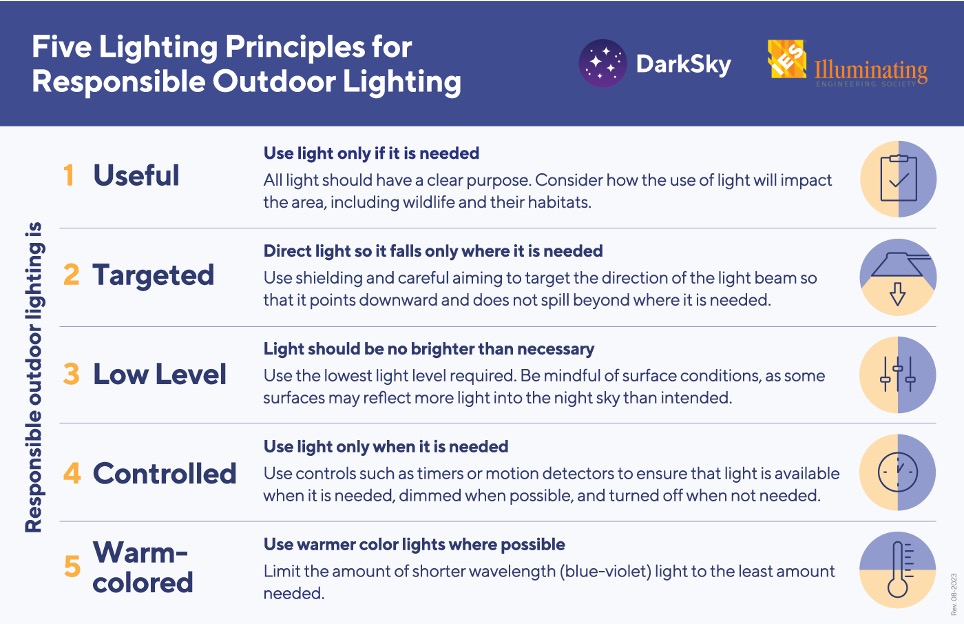
When we apply these five principles together we create lighting that is beautiful, functional, and respectful of the night. We protect migratory birds that navigate by starlight. We safeguard nocturnal pollinators that feed under the cover of darkness. We preserve the cultural heritage embedded in night skies. We restore our own connection to nocturnal rhythms.
At Noctura, we believe that reclaiming the night doesn’t need to be about returning to a pre-electric past. It’s about moving forward with wisdom, designing our relationship with light in a way that honours both day and night. The principles are simple, but their impact is profound: light where you need it, when you need it, in the amount needed, and no more.
Learn more about responsible outdoor lighting at DarkSky International